
Modern Lawyers is an elective course at the Faculty of Law, Charles University, where students learn to approach legal problems through innovation, technology, design, and experimentation.
I have been teaching and continuously developing the course since October 2022.
This page documents its philosophy, learning objectives, visual identity and tooling, and additional resources, as a resource for anyone interested in teaching legal innovation.
Course philosophy
- Law is a material: law is not an end goal, fulfilling legal needs is
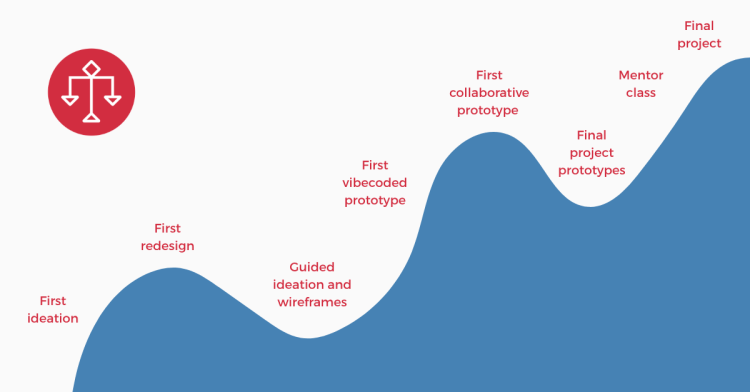
- Creative confidence: we do small things first and gradually build towards making an epic final project that the students are proud of
- Individual agency: students set their own goals, their own benchmarks, the class gives them what they need
- Learning with, not just about, technology: students actively use tech tools to build, while testing their effectiveness and limits
- Feedback is a gift: students get and give tons of feedback, from one another, me, their mentors, and our guests
Learning objectives
At the end of the class, the students can
- Design and test creative solutions to legal problems using appropriate methods and technologies
- Analyse and justify the impact of their design decisions on users and the wider system
- Explain the main trends in law (e.g. Legal Tech, AI, and legal design) and their impact on the work of lawyers
- Create and test a prototype (e.g. a document, application, or service) that addresses a specific legal problem
- Critically evaluate the outputs of generative artificial intelligence and use them in solving a legal problem
- Collaborate in a team, give and receive feedback, and incorporate it into their project
- Clearly present and defend their solution.

Visual identity and tooling
The class has a distinctive visual identity, which carries across a wide range of paper and digital artefacts. These include absence tracking cards, prompting cards, worksheets, as well as vibecoded apps.
The cornerstone is a logo that I designed, which combines the justice scales with a technical process diagram.


Reflections of the past semesters
- Eight semester had first sessions on Legal Futures and AI-Native Law Practice, and a major interest in Lovable (read the full reflection)
- Sixth semester was the first one where students used Notion to organize their project and review comprehensive readings, while exploring vibecoding (read the full reflection)
Learn more about Modern lawyers
- Legal Tech Demo Gallery: a vibecoded tool that enables students to take their first exploration of the legal tech tooling
- Rapid Prototyping of Legal Tech and Design using Generative AI: an article I wrote for the MIT Computational Law Review about the key building blocks of the course
- Alternative legal professions: a framework for introducing multidisciplinary professions to the students
- How we use Generative AI in the classroom: note that this is as of June 5, 2024 – a lot has changed since then
- Data-driven legal design class: how I worked with feedback to develop a completely new curriculum
- Designing the course map: detailed account on how I structure one of the course’s key artefacts